Suboccipital Muscles, Fascia and Headaches
– an often overlooked cause
Introduction
If you experience neck pain or headaches, you probably reach for your shoulders first. You massage them, move them, maybe stretch a bit. In many cases, this helps – but it doesn’t always solve the problem.
The reason is often that the source of the problem is not where we feel the pain.
At the base of the skull, hidden deep beneath the surface, there is a small group of muscles that rarely gets attention, yet plays a key role in headaches and neck tension. These are the suboccipital muscles.
Modern lifestyle – working at a computer, using smartphones, and maintaining a forward head posture – places these muscles under constant low-level strain. Although small, their overload can cause disproportionately strong symptoms: pain at the back of the head, neck stiffness, or a hard-to-describe “helmet-like” tension.
This article will help you understand this often overlooked area and show you simple, targeted ways to relieve the tension.
Click on the images to view them in full size.
Anatomy – the “invisible” muscles
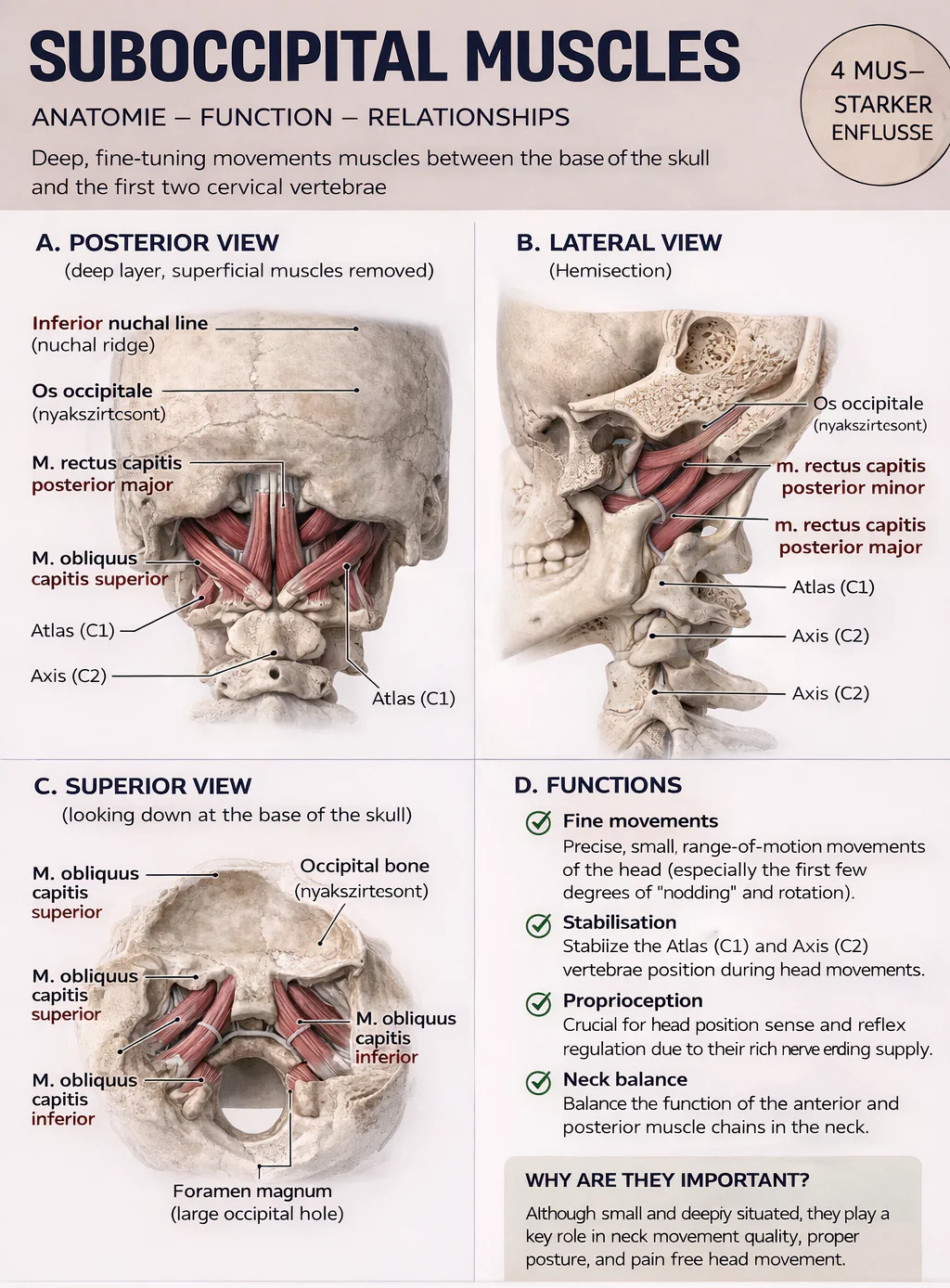
At the base of the skull, four small muscles are located:
- m. rectus capitis posterior major
- m. rectus capitis posterior minor
- m. obliquus capitis superior
- m. obliquus capitis inferior
These are not large, force-generating muscles. Instead, they play a fine-tuning role: they precisely position the head and stabilize the upper cervical spine.
That is exactly why they are so sensitive to poor posture.
Why do they become overloaded?
The answer is simple: because we use them almost constantly.
For example, when we:
- look down at our phones
- sit leaning forward at a computer
- or simply let the head drift slightly forward
these muscles are under continuous, low-level tension.
This is not a dramatic load, but rather a constant micro-tension that over time:
- shortens the muscles
- creates sensitive trigger points
- and leads to radiating pain
Typical symptoms
Overloaded suboccipital muscles often produce a characteristic pattern:
- dull, pressure-like pain at the back of the head
- pain that “moves upward” toward the top of the head
- neck stiffness
- tension behind the eyes
- symptoms worsening after prolonged sitting
These symptoms are often not directly associated with the neck.
Fascia connection – why it’s not just about the neck
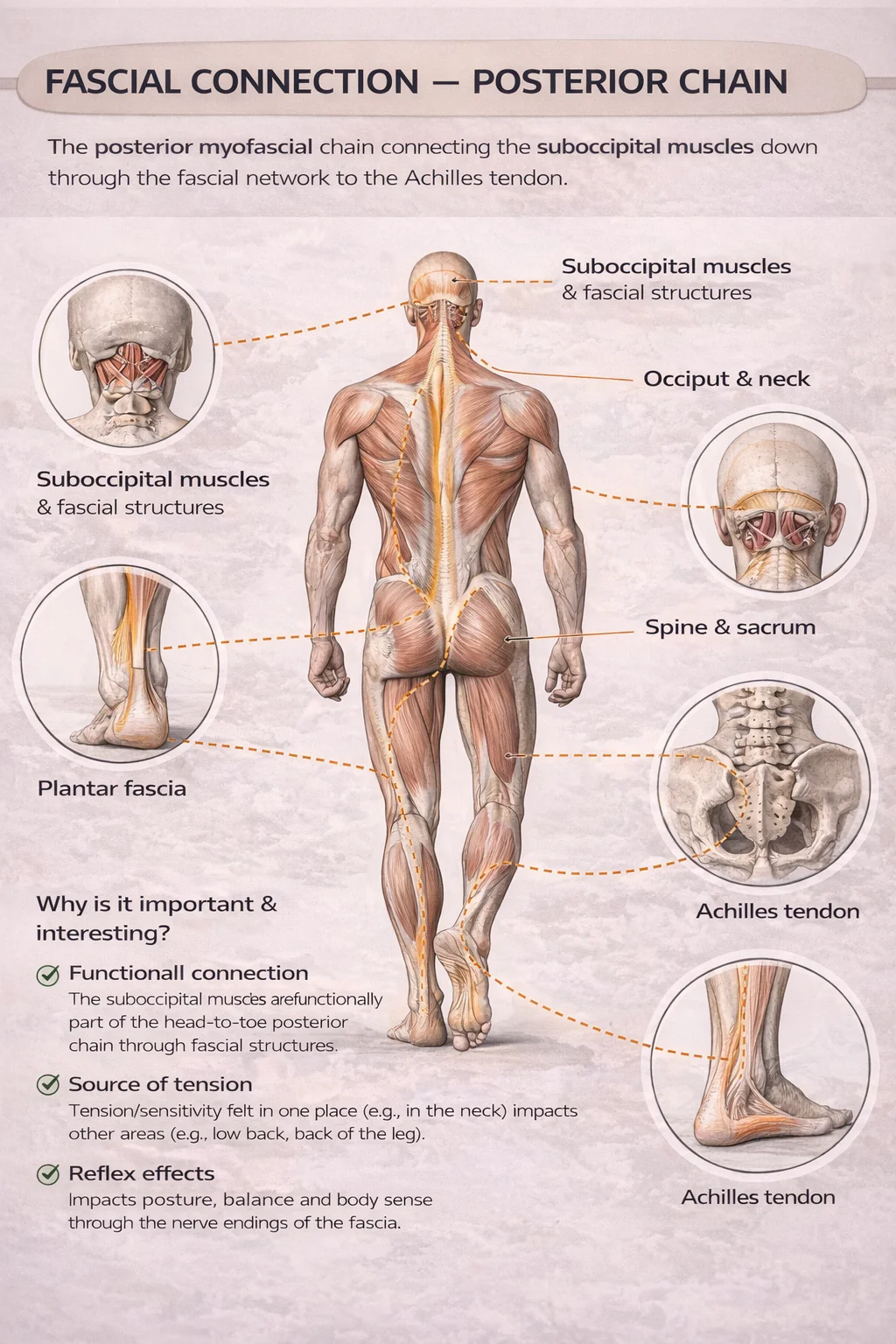
The body does not function as separate parts, but as an interconnected system.
The suboccipital muscles are part of a long structure known as the posterior fascial chain, which:
- starts at the skull
- runs along the spine
- and extends all the way to the legs
This means:
- tension in the neck can affect the back
- lower back issues can feed back into the neck
The body works as a whole.
Fascia itself is not just a passive “connector”, but an active tissue.
When exposed to prolonged tension or repetitive loading, the connective tissue can:
- lose elasticity
- become less hydrated
- and develop microscopic adhesions and cross-links
This process is often associated with changes in fibroblast activity, leading over time to increased tissue stiffness.
As a result, fascia can feel “shortened” and tight, and becomes less capable of distributing mechanical load effectively.
Under normal conditions, fascia plays an important role in:
- reducing the load on muscles
- distributing mechanical forces
- supporting efficient movement
When it becomes stiff, these functions are compromised, and muscles – such as the suboccipital muscles – are more likely to become overloaded.
What can you do? – simple, targeted exercises
The good news is that you don’t need complicated tools. A few simple, well-executed movements can make a big difference.
Even 1–2 minutes per day can be enough to noticeably reduce tension.
Chin tuck – the foundation movement
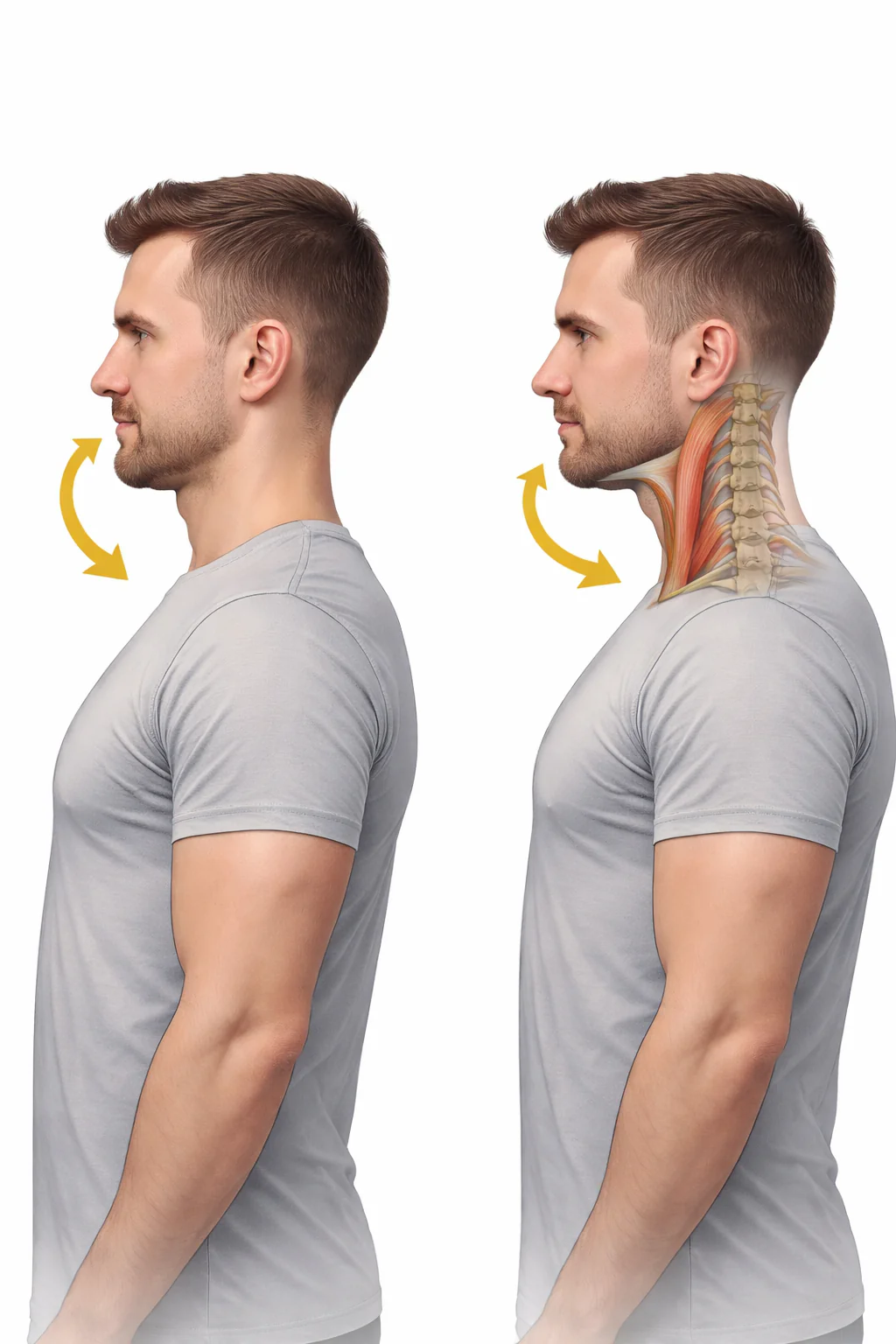
This exercise activates the deep neck muscles and helps restore the natural head position.
How to perform:
- maintain an upright posture
- gently draw the chin backward (not downward!)
- keep the head from dropping forward
- hold for 5–10 seconds
The movement may feel subtle, but it is highly effective.
Rotated micro-nod – the key exercise

This movement directly targets the suboccipital muscles.
Starting position:
- upright posture
- head turned about 30° to one side
Movement:
- a small “yes” nod
- the motion occurs at the base of the skull
- the chin moves closer to the neck
- the gaze shifts slightly downward
Important: this is not a full head drop. The movement is small and controlled.
Repetitions:
- 5–8 per side
- 1–2 minutes daily is sufficient
Prevention – small changes, big impact
The best treatment is prevention.
- position your monitor at eye level
- avoid using your phone in your lap
- take regular breaks
- pay attention to your head position
Summary
The suboccipital muscles are small but have a significant impact on how we feel. Because they are hidden deep, they are often overlooked in stretching and relaxation routines.
Yet in many cases, they are the real source of persistent headaches.
By understanding how they work and incorporating just 1–2 minutes of targeted movement into your daily routine, you can often experience surprisingly fast improvement.
If you take away just one thing:
the rotated micro-nod is one of the simplest and most effective ways to relieve tension in this area.